

Running an HVAC business takes more than technical skill. It takes capital. Between the service vans, the diagnostic tools, the commercial units you’re installing, and the refrigerant handling equipment you need just to show up to a job legally, the startup and growth costs add up in a hurry. And for most HVAC contractors, the gap between the work they could be doing and the work they’re actually landing comes down to one thing: equipment they haven’t been able to afford yet.
That’s the problem HVAC equipment financing is built to solve. Instead of waiting years to save up for the next van or the next set of commercial units, you put the equipment to work now and pay for it over time with the revenue it generates. Here’s a straightforward look at how it works in 2026.
The range is wider than most people expect, and it scales fast as you move from residential service work into commercial installs.
On the tools and diagnostic side, a fully stocked HVAC service van typically carries $5,000 to $8,000 worth of tools and diagnostic equipment not including the vehicle itself. That includes digital manifold gauge sets, which run $150 for basic analog models up to $600 or more for wireless digital versions, vacuum pumps in the $250 to $600 range, refrigerant recovery machines, leak detectors, multimeters, and the full assortment of hand tools a tech carries on every call. Commercial installation trucks can carry $10,000 or more in specialized gear and rigging equipment on top of that.
On the system side, the numbers get significantly bigger. According to commercial HVAC pricing data from Atlas AC Repair, commercial condenser units alone range from roughly $4,000 to over $22,000 depending on tonnage and efficiency rating. Small commercial rooftop units start around $15,000 installed, with larger advanced systems running $50,000 or more. When you factor in installation labor, permits, crane rental for rooftop work, and refrigerant, a single commercial HVAC job can represent a $25,000 to $80,000 equipment decision for the building owner and a significant capital investment for the contractor doing the work.
Even residential service and replacement work adds up. A van, a full set of tools for each tech, and the inventory to handle jobs without waiting on parts orders puts most growing HVAC businesses in a position where HVAC equipment financing isn’t just convenient; it’s necessary.
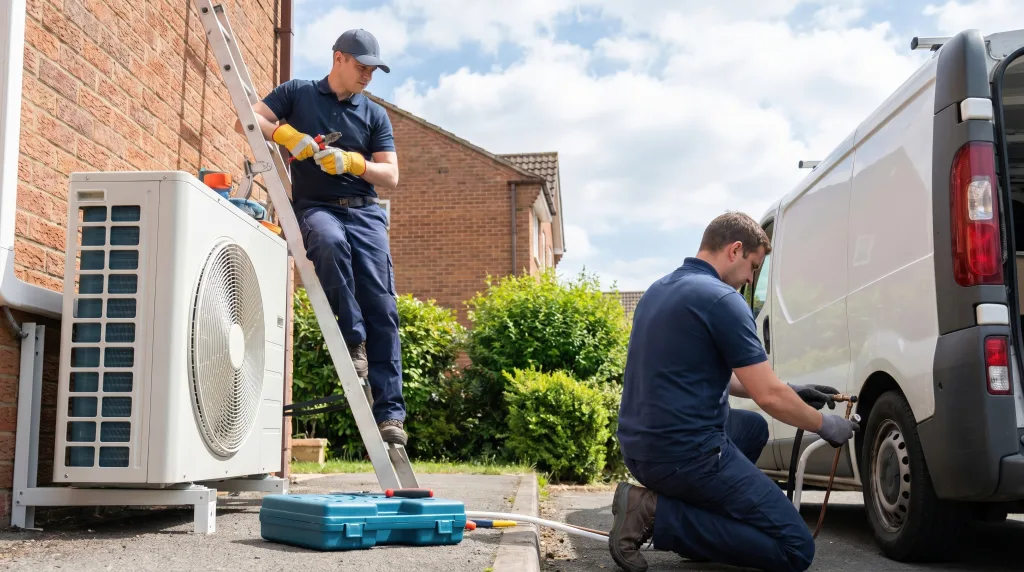
This is where a lot of HVAC contractors are surprised. HVAC equipment financing doesn’t stop at just rooftop units and condensers. Most equipment lenders will finance service vans and work trucks, diagnostic tools and manifold gauge sets, vacuum pumps and refrigerant recovery machines, commercial HVAC systems being installed on customer properties, ductwork fabrication equipment, lifts and rigging equipment for commercial installs, and in some cases, refrigerant inventory for contractors who maintain their own stock.
The van piece is worth calling out specifically since a lot of HVAC business owners don’t realize their service vehicle qualifies as financeable equipment. If you need a second van to run a second crew, that’s a financing conversation, not a cash conversation. Financing the full working setup — van, tools, and diagnostic equipment — as one package rather than piecing it together out of pocket is often the cleaner move.
One of the most common questions from HVAC contractors is whether a newer business can actually get approved. The answer is yes, and the HVAC industry is actually a favorable one for equipment financing because the equipment is income-generating from day one. A financed service van and tool set starts paying for itself the first week it’s on the road.
For startups, having the required down payment ready is the most important factor. Lenders are looking for evidence that the business has some skin in the game when there’s limited operating history to review. For established HVAC businesses with a year or more of revenue and a track record of completing jobs, the process is much more straightforward and approvals can move in as little as 24 hours on a complete application.
The seasonal nature of HVAC work is something worth being upfront about during the application process. Lenders who specialize in equipment financing understand that cash flow in the HVAC industry isn’t perfectly linear, and that context matters.
The approval factors are consistent across most equipment lenders. Time in business is the first thing reviewed. An HVAC company that’s been operating for two or three seasons has a real track record. A brand-new entity doesn’t, and lenders will price that difference into the terms accordingly.
Revenue and cash flow come next. Lenders want to see that the new monthly payment fits comfortably into what the business is already generating, which means having a clear picture of your monthly revenue and operating expenses before you apply makes the conversation a lot smoother.
The equipment itself matters too. A new Carrier rooftop unit or a current-year Ford Transit is a cleaner approval than a 15-year-old piece of equipment with unclear service history. For used equipment, having the make, model, year, and condition documented upfront speeds up the process considerably.
Personal credit still plays a role, especially for smaller and newer operations, but working with an equipment-focused lender gives you more flexibility than a traditional bank because the equipment itself serves as collateral.
One thing a lot of HVAC business owners overlook is how favorable the tax treatment is for financed equipment. The Section 179 deduction for 2026 allows businesses to deduct up to $2,560,000 in qualifying equipment placed into service during the year, and it applies whether you paid cash or financed the purchase.
For an HVAC contractor financing a new van, a set of diagnostic tools, and a commercial unit, that could mean writing off the full cost of everything this year on taxes while still making monthly payments. It’s a combination that makes financing particularly attractive from a cash flow standpoint, and one that often surprises business owners who assumed they’d have to own the equipment outright to get the deduction. Talk to your accountant before finalizing anything since eligibility depends on your specific tax situation, but it’s worth the conversation.
A lot of HVAC equipment financing conversations start with one specific piece of equipment, a van, a rooftop unit, or a new recovery machine. But bundling multiple pieces into a single loan is often cleaner than doing them one at a time. One application, one approval, one monthly payment.
If you’re building out a second crew from scratch, thinking about the full equipment package as one financing conversation is usually the smarter move. Van, tools, diagnostic equipment, and anything else needed to put that crew on the road profitably can often be bundled together and financed as a package.
The worst time to start a financing conversation is when you’re already stretched thin and the next job depends on equipment you don’t have yet. The best time is before that pressure exists.
Getting prequalified costs nothing and puts you in a position to move fast when the right opportunity comes up, whether that’s a commercial contract that requires additional capacity or a deal on a piece of equipment that won’t last long on the market.
TrueCore Capital works with HVAC contractors and service businesses to structure equipment financing around the real demands of running and growing an HVAC operation, including vans, tools, and commercial systems. If you’re also considering a cargo van for your next crew, that can often be bundled into the same deal.
Find out what you qualify for today. Give us a call at (805) 422-7342 or submit a contact form below to get started — no hard pull, no pressure.



 July 5, 2024
 July 5, 2024
 July 5, 2024


 by Augustine Sung